How to Fix 3 Massive Gaps in Your LLM Observability Stack
You shipped your LLM powered application to production. Users are hitting it. And somewhere in the back of your mind is a quiet, persistent question you cannot fully answer: is it actually working? I explained how to scale PoC to Prod ready LLM base application and now let’s understand why LLM Observability is important.
Not “is it up?”, your uptime monitor covers that. The harder question is whether the responses are accurate, whether the retrieved context is relevant, whether the model is drifting as queries shift week over week, and whether you are burning ten times more tokens than you need to. Traditional application monitoring has no concept of these problems. It will tell you the API returned a 200 and that latency was 340ms. It cannot tell you whether the answer was hallucinated.
This is the gap LLM observability is designed to close. And in 2026, most enterprise teams building on LLMs are still operating with an instrumentation gap wider than they realize.
Why traditional APM fails at LLM observability
Application performance monitoring was designed for deterministic systems. A function either runs or it does not. A database query either returns rows or it errors. The behavior is consistent, the same input produces the same output.
LLMs are non-deterministic by design. The same prompt, with the same retrieved context, can produce meaningfully different responses depending on temperature settings, model version, and subtle token ordering. You cannot assert correctness the way you assert that a REST endpoint returned a valid schema. You have to measure it.
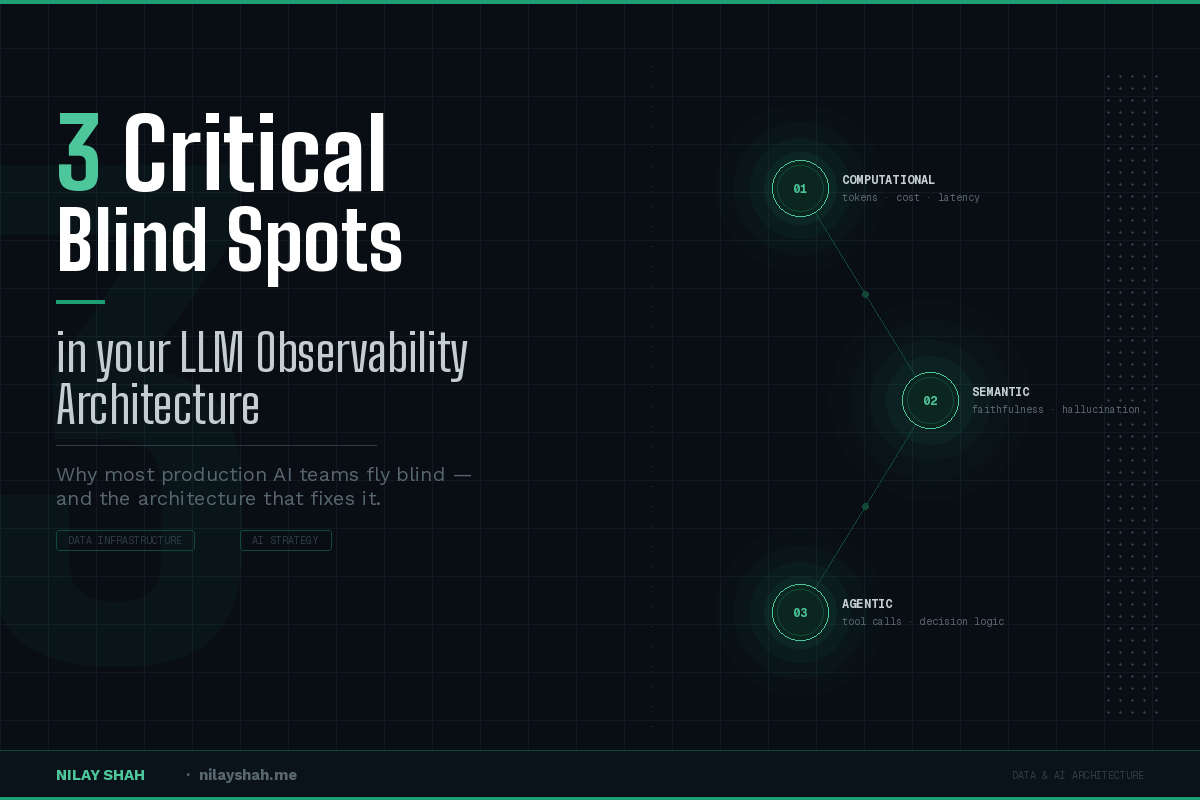
This is a fundamentally different LLM observability problem. And it splits into three distinct layers that most teams conflate into a single dashboard when they should be treating them as separate engineering concerns.
The three layers of LLM observability
Computational observability is the closest to traditional APM. It covers token consumption, API latency, error rates, provider availability, and cost per request. This is the layer most teams instrument first because it resembles infrastructure monitoring. The failure mode here is treating it as sufficient. Knowing you spent $4,200 on tokens last week tells you nothing about whether any of that spend produced useful responses.
Semantic observability is where the genuinely new engineering discipline lives. It covers output quality: is the response faithful to the retrieved context, is it relevant to the query, does it contain hallucinated facts, does it violate your content policies? These signals cannot be captured from HTTP headers or response codes. They require evaluation models or structured scoring functions running against the content itself. According to hallucination benchmarking research from Cleanlab, poorly evaluated RAG systems can produce unfaithful responses in up to 40% of cases even when the correct information is present in the retrieved context.
Agentic observability is the newest and least mature layer. For systems using autonomous agents tool-calling, multi-step reasoning, or orchestration across multiple models, you need to capture the full execution trace: which tools were selected, what arguments were passed, what state the agent maintained between steps, and where in the decision chain things diverged from expected behavior. A single agent response may span dozens of internal operations that are completely invisible to the application layer above.
Three-layer LLM observability architecture
Most teams reach for a single LLM observability platform and assume it covers all three layers equally well. It does not. The architecture question is which layers carry the most business risk for your specific system and instrument those first.
The gateway: your AI control plane
Before any of the observability machinery becomes useful, you need a single chokepoint through which all LLM traffic flows. That is the LLM gateway.
The gateway sits between your application layer and the model providers. It handles model routing, failover, semantic caching, rate limiting, cost tracking, and guardrail enforcement. It is the infrastructure layer that makes everything else traceble, because without centralized traffic interception, your observability data is scattered across a dozen different SDK integrations and provider dashboards.
Model routing deserves more architectural attention than it typically receives. The default for most teams is to route all requests to a single model usually the most capable one available. This is operationally simple and financially expensive. A well-configured routing layer classifies requests by complexity and routes accordingly: simple factual lookups to a lightweight, fast model; complex synthesis or multi-step reasoning to a mid-tier model; the small fraction requiring maximum fidelity to a frontier model. Real-world deployments report cost reductions of 60-80% after implementing complexity-aware routing, with no measurable degradation in user-facing quality for the majority of requests.
The architectural implication is significant: your gateway is not just a proxy, it is a cost optimization layer that the data platform team should own, not delegate to individual application teams.
Guardrail enforcement belongs at the gateway level for the same reason. Prompt injection detection, PII filtering on inputs, topic constraints, and output content filtering applied per-service create duplication and inconsistency. Applied at the gateway, they become a policy enforcement point that is auditable, testable, and upgradeable independently of application logic.
LiteLLM remains the most widely adopted open-source gateway for teams in the early scaling phase. Its OpenAI-compatible interface and support for 100+ providers make it straightforward to adopt. At high-concurrency scale, its Python runtime introduces latency overhead that Go-based alternatives avoid but for most enterprise use cases, it provides a strong starting point before a gateway migration becomes necessary.
Evals in production: the online and offline distinction
The evaluation problem in LLMOps borrowed its vocabulary from classical ML but has not fully worked through its implications. Teams speak of “running evals” as if it were a single activity. In production, it is two distinct activities with different purposes and different failure modes.
Offline evaluation runs against a static dataset of golden cases before any deployment goes live. You maintain a curated set of input/context/expected-output triples, and you gate deployments on score thresholds against that set. This is your regression testing layer. RAGAS provides a reference implementation for RAG-specific offline evals, measuring faithfulness, context precision, context recall, and answer relevancy without requiring human-annotated ground truth for every case a meaningful practical advantage when building evaluation datasets from scratch.
Online evaluation runs continuously against live production traces, applying scoring functions to real user interactions as they occur. This is your drift detection layer. User query distributions shift. Retrieved context quality degrades as underlying data sources change. Model versions get silently updated by providers. None of these regressions surface in offline eval because your golden dataset does not reflect the new distribution.
LLM-as-judge: using a capable model to score the outputs of your production model has become the dominant online evaluation pattern. It is imperfect judge models carry their own biases and can be gamed by outputs that superficially match expected patterns. The practical mitigation is to run multiple scoring approaches in parallel, validate your judge against human-labeled subsets periodically, and track judge-to-human agreement as a first-class metric.
The architectural discipline that matters most here is closing the loop. Most teams instrument traces and compute eval scores but stop there. The feedback loop that converts low-scoring production traces into new offline eval cases, and those cases into improved prompt versions registered in a prompt registry, is where the real operational value lives. Without that loop, you have a dashboard. With it, you have a system that improves.
The self-hosting question
Here is where enterprise architecture diverges sharply from the developer tooling narrative.
Every major SaaS observability platform: Langfuse Cloud, Arize Cloud, LangSmith, Helicone operates by ingesting your production traces, the actual prompts, retrieved contexts, and model responses from your live system. For teams working with public-domain data and no regulatory exposure, this is a reasonable operational choice. For teams in financial services, healthcare, manufacturing, or any context where EU AI Act compliance is a live concern, sending production traces to a third-party SaaS platform is a hard compliance problem, not a configuration decision.
Self-hosted observability closes that gap. The architectural principle extends beyond tool selection: any component that ingests production inference data is a data governance concern, not just an engineering tooling concern. It belongs in your data architecture review, with the same scrutiny you would apply to any system touching sensitive data.
Contrarian take: you probably have observability theater
There is a failure mode common enough to name. Teams instrument their LLM systems thoroughly traces, eval scores, cost dashboards, latency percentiles and then use none of it to change anything. The dashboards are green enough that no one escalates. The eval scores are stable enough that no one investigates.
This is observability theater. It creates the sensation of visibility without the operational discipline to act on what the visibility reveals.
The expensive lesson is that data quality in the underlying knowledge base degrades silently. Retrieved documents become stale. Semantic search quality shifts as user vocabulary evolves. Prompt templates that worked well in March are subtly mismatched to the June query distribution. None of these degradations are dramatic. They produce a slow erosion of answer quality that shows up in user satisfaction signals long before it surfaces in eval scores.
The teams that catch this early are not the ones with the best dashboards. They are the ones with a weekly discipline of sampling production traces, reading actual inputs and outputs, and asking whether the system is doing what they think it is doing. No amount of automated scoring replaces a human who is paying attention.
Tool worth attention: Langfuse
Of the LLM observability platforms available in 2026, Langfuse earns specific attention for enterprise teams.
It is MIT-licensed and fully self-hostable, which resolves the data governance concern immediately. It uses OpenTelemetry as its tracing standard, which means it does not require SDK lock-in any framework that emits OpenTelemetry traces integrates natively. It ships prompt management alongside observability, so prompt versions are first-class objects linked directly to the traces they produced, making regression analysis tractable. It has the most active open-source contributor community in the LLM observability space.
The limitation worth naming: Langfuse’s evaluation primitives are lighter than Arize Phoenix’s ML-grade rigor. For teams running mixed workloads traditional ML models alongside LLMs Arize provides more unified instrumentation. For teams whose observability scope is LLMs and agents only, Langfuse is the right starting point.
7 things to keep in mind
- Computational observability covers cost, latency, and errors necessary, but not sufficient. Most teams stop here.
- Semantic observability requires evaluation models running against content, not just metadata from the HTTP layer.
- Agentic observability is a separate engineering concern from both it tracks decision logic, not just inputs and outputs.
- Complexity-aware model routing reduces LLM spend by 60-80% with no quality degradation for the majority of requests.
- RAG systems without eval pipelines produce unfaithful responses in up to 40% of cases even when correct information is retrieved.
- LLM-as-judge is the dominant online eval pattern and it requires its own validation layer to remain trustworthy over time.
- SaaS observability platforms send your production traces off-premises; for regulated workloads, self-hosting is the enterprise default.
The rule of thumb
If you are running an LLM application in production and cannot answer these three questions from your instrumentation, your LLM observability stack is incomplete:
- What percentage of responses last week were faithful to the retrieved context?
- What did the system cost per useful response, accounting for routing and caching?
- How many low-quality production traces were converted into new eval cases this month?
The first is a semantic observability question. The second is computational and architectural. The third is a feedback loop question.
Most teams can answer the second. Fewer can answer the first. Almost none can answer the third.
Build the loop before you build the dashboard.
References
- LLMOps for Enterprise Generative AI: Architecture, Observability, and Scalable AI Operations — Fractal Analytics
- Agent Observability: The Complete Guide for 2026 — Braintrust
- LLM Observability: LangSmith vs Arize vs Langfuse vs W&B — Kanerika / Medium
- LLM Observability on GPU Cloud: Self-Hosted AI Tracing — Spheron Blog
- Top 5 LLM Gateways in 2026: A Production-Ready Comparison — Maxim AI
- Model Routing LLM: 7 Strategies to Reduce Token Cost — Abhyash Suchi
- Benchmarking Hallucination Evaluation for RAG — Cleanlab
- Real-Time Evaluation Models for RAG: Who Detects Hallucinations Best? — arXiv
- The 5 Best RAG Evaluation Tools in 2026 — Maxim AI
- LiteLLM — BerriAI GitHub
- AI Agent Cost Optimization: Token Economics and FinOps in Production — Zylos Research
- Top AI Observability Trends Shaping 2026 Ops Teams — Rootly
What is LLM observability architecture?
LLM observability architecture is the system of instrumentation, data collection, and evaluation pipelines that give you visibility into whether an AI system is producing accurate, faithful, and cost-efficient responses in production. It spans three layers: computational (tokens, cost, latency), semantic (faithfulness, relevance, hallucination), and agentic (tool calls, decision logic, state transitions).
What is the difference between LLM observability and traditional MLOps observability?
Traditional MLOps observability monitors deterministic models where the same input reliably produces the same output. LLM observability must handle non-determinism — the same prompt can produce different responses — so correctness cannot be asserted from HTTP status codes alone. It requires semantic evaluation models running against content to measure output quality.
What is the best open-source LLM observability tool for enterprise?
Langfuse is the strongest open-source option for enterprise teams in 2026. It is MIT-licensed, fully self-hostable on Postgres and ClickHouse, uses OpenTelemetry for framework-agnostic tracing, and ships prompt management alongside observability. For teams with mixed ML and LLM workloads, Arize Phoenix offers more unified instrumentation.
What is the difference between online and offline LLM evaluation?
Offline evaluation runs against a static golden dataset before deployment — it is your regression testing layer. Online evaluation applies scoring functions to live production traces continuously — it is your drift detection layer. Both are necessary: offline catches regressions before they ship, online catches degradations that only appear with real user query distributions.
Should I self-host my LLM observability stack or use a SaaS platform?
SaaS LLM observability platforms ingest your production traces the actual prompts, retrieved contexts, and model responses. For unregulated workloads this is operationally convenient. For enterprise teams in financial services, healthcare, or manufacturing with EU AI Act obligations, self-hosting is the default: your inference data stays on infrastructure you control, under audit trails you own.