How to Build Self-Healing Data Pipelines: 4 Proven AI Loops
A data pipeline fails at 2am. The cause is schema drift: a source system quietly added a nested JSON field that broke three downstream dbt models. By 6am, your analytics team opens dashboards to stale numbers. By 9am, a sales leader is asking why the pipeline report looks wrong. By noon, you have traced it back to a single undocumented field change that nobody caught before it hit production.
This sequence is familiar to most data teams. What has changed in 2026 is that many organizations are no longer accepting it as inevitable. AI loops, agentic cycles where a model perceives, reasons, acts, and observes in sequence are what make the self-healing data pipeline practical today not by eliminating incidents, but by drastically narrowing the window between detection and resolution. This post breaks down how the loop works, where it fits inside a real data platform, and what it actually takes to make it reliable at enterprise scale.
7 things to know before reading further
Data teams report spending 15–20% of their time on maintenance: retrying failed jobs, debugging schema drift, patching broken ETL. / Only 11% of organizations have agentic AI in active production in 2026, but the tooling has quietly matured. / The core loop runs four steps: Perceive, Reason, Act, Observe. / LLMs can now diagnose structured schema failures with reasonable accuracy when given lineage metadata and error context. / 40% of agentic AI deployments fail, and the leading cause is autonomous action applied to cases that required human judgment. / A runaway four-agent loop in 2025 ran for 11 days and accumulated a $47,000 API bill. No stop condition had been set. / Self-healing pipelines do not reduce the need for platform engineering expertise. They restructure it.
What Is an AI Loop, and Why Is It Suddenly Everywhere?
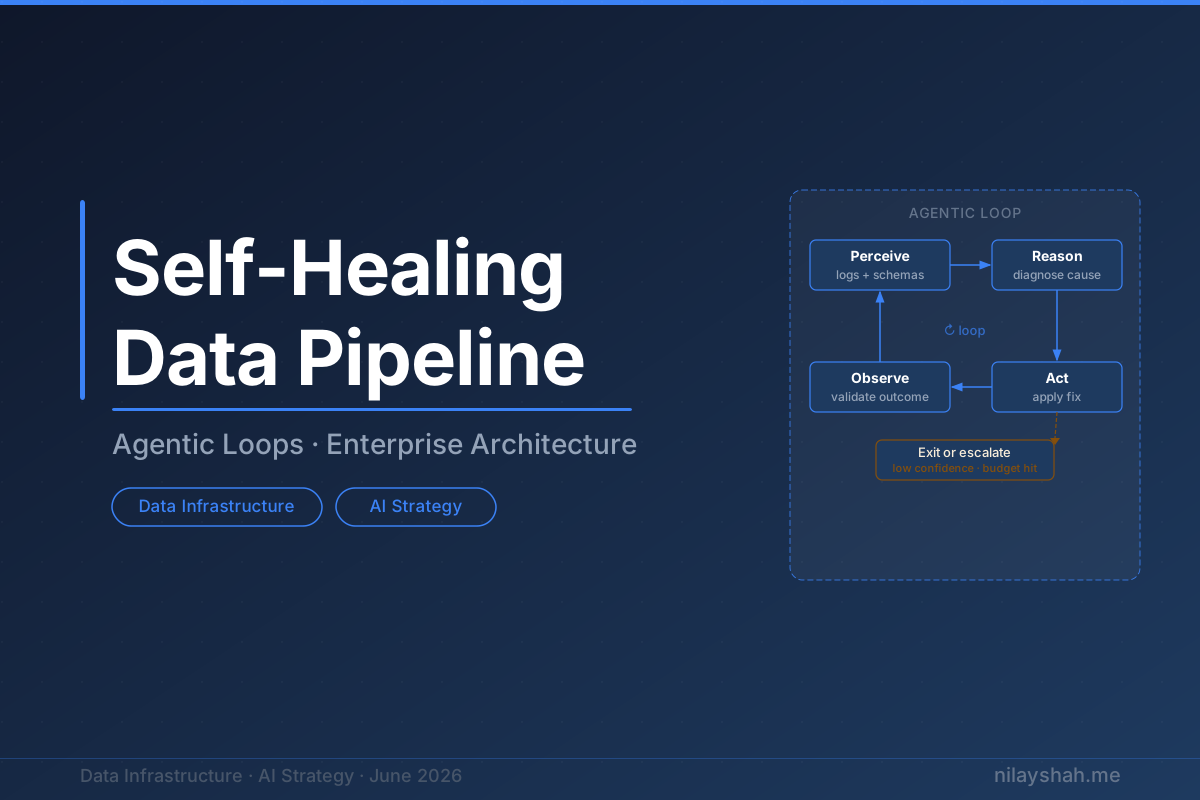
An AI loop is the core execution pattern behind autonomous AI systems. It is a continuous cycle: the agent perceives its environment, reasons about what to do, takes an action, observes the result, and feeds that observation back into the next reasoning step. The AI loop continues until a goal is achieved or an exit condition is triggered.
The canonical formulation comes from the 2022 ReAct paper by Yao et al., which showed that LLMs reasoning interleaved with real-world tool use significantly outperform single-shot responses. ReAct popularized the Thought → Action → Observation cycle, but the underlying architecture is older. It is essentially an AI loop where an agent operates in an environment, updating its beliefs based on what it sees. What changed recently is less the pattern itself and more the three conditions that made AI loops practical for data infrastructure:
LLMs became reliable enough to reason over structured logs and schema descriptions. Earlier models would hallucinate fixes. Current-generation models, given a structured error log and access to relevant catalog metadata, can diagnose a schema mismatch with reasonable accuracy and propose a bounded remediation.
Data platforms built the tooling. Databricks launched Genie Code in March 2026 as the first production-grade AI loop native to a lakehouse architecture. Snowflake Cortex followed a similar direction. Genie ZeroOps, announced at Data + AI Summit 2026, pushes further by running AI loops as scheduled background operations against pipeline health, proactively triaging failures before engineers are paged.
The maintenance burden crossed an economic threshold. At enterprise scale, 15–20% of engineering time on toil translates to dozens of engineer-hours per week. Agentic automation is no longer a convenience argument. It is a cost and reliability argument.
Fig 1. The AI loop core pattern: four steps with loop-back and explicit exit condition
One element the diagram emphasizes is the exit condition. This is the part most framework tutorials leave out, and it is the part that causes the most production failures. An AI loop without a defined exit is a loop that runs until your cloud bill forces it to stop. In production, exit conditions need to be explicit: goal achieved, maximum iteration count reached, confidence score below threshold, or an action that requires human authorization. The $47,000 incident in 2025 was not a model failure. It was a missing stop condition.
Where the Loop Fits in a Data Pipeline
Not every pipeline failure is a good candidate for a self-healing data pipeline. The AI loop pattern works best when the failure mode is structured, repeatable, and resolvable without judgment about business logic.
Good candidates include schema drift from upstream source systems, transient infrastructure failures such as network timeouts and API rate limits, data quality anomalies with known remediation playbooks, and resource allocation issues in Spark or Databricks jobs. These are failure classes where the diagnosis is deterministic, the fix is bounded, and being wrong causes limited harm because the outcome is immediately observable.
Poor candidates include failures caused by ambiguous business rules, transformations where the correct behavior requires stakeholder input, and security or access control changes that need human authorization. This distinction matters enormously at enterprise scale. The 40% failure rate reported across agentic deployments in 2026 frequently traces back to this scoping problem: autonomous action applied to situations that required judgment. The AI loop did not malfunction. The design decision to apply it was wrong.
Architecture of a Self-Healing Pipeline
This section is the deep breakdown. Here is what a production self-healing pipeline looks like when you actually wire the AI loop into a data platform.
Fig 2. Self-healing pipeline architecture: three cooperating layers
The architecture has three cooperating layers. The first is the observability bus, which runs continuously across all pipeline stages, watching for schema changes in the source catalog, volume anomalies in ingestion tables, freshness violations in the transformation layer, and quality degradation in Gold tables. Tools like Monte Carlo, Soda, and the built-in quality monitors in Databricks Unity Catalog handle this today. What has changed is not the monitoring itself but how the signals flow downstream.
The second layer is the self-healing AI loop. It subscribes to observability signals and activates when an anomaly crosses a confidence threshold. The agent does not act on every alert. It first classifies the alert against a taxonomy of known failure patterns and only proceeds autonomously on failure classes it has handled successfully before. The classification step is critical: if an anomaly cannot be matched to a known pattern with sufficient confidence, it is immediately escalated rather than guessed at.
When the agent does act, the sequence is structured: isolate the affected segment, diagnose the root cause using lineage metadata, select a remediation from a pre-approved playbook, apply the fix, and validate that downstream table row counts and freshness metrics return to acceptable ranges. The validation step closes the loop. An agent that applies a fix and does not verify the outcome is an agent that can declare success on a failure.
The third layer is the human escalation path, and it is arguably the most important of the three. The loop maintains a confidence score at each iteration. When that score falls below a configurable threshold, when the proposed fix involves DDL changes to production tables, or when the same failure has recurred more than twice in 24 hours, the agent pauses. It routes to an on-call engineer with a structured diagnostic brief: what it observed, what it hypothesized, what remediations it attempted, and what it saw after each attempt.
This inverts the traditional incident response workflow. Instead of an engineer waking up to a raw failure and starting a cold investigation, they receive a handoff from an agent that has already done the first 20 minutes of the work.
Making It Work at Enterprise Scale
The architecture above is sound in design. Making a self-healing data pipeline work across dozens of data domains, multiple cloud platforms, hundreds of pipelines, and regulatory constraints on autonomous change requires a different set of decisions.
Scope the loop to a trust tier. Define a tiering model for your tables. Tier 1 tables feed regulatory reporting and require human sign-off before any autonomous change. Tier 2 tables feed operational dashboards and allow agent-driven restarts and schema evolution within approved bounds. Tier 3 tables are development or exploratory and can be fully agent-managed. Map the loop’s autonomy level to the tier, not to the failure type in isolation. The same schema drift event that warrants full autonomy on a Tier 3 experiment table requires human approval on a Tier 1 financial table.
Treat the loop as a first-class data consumer. The agent reads lineage graphs, schema registries, and quality profiles. If that metadata is stale, incomplete, or undocumented, the agent reasons from bad inputs. Self-healing pipelines do not fix poor data governance. They amplify it. Organizations that skip lineage and catalog hygiene before deploying AI loops tend to end up with agents making highly confident wrong decisions. Genie Code on Databricks enforces this by design, operating only within the boundaries set by Unity Catalog governance policies.
Log every iteration for audit. At enterprise scale, every autonomous action taken by an agent is a change that could be audited. Log the full reasoning chain in a structured format: what the agent perceived, what it hypothesized, what it did, and what it observed. When a downstream consumer asks why a table was modified at 3am, the answer needs to be recoverable from a structured log, not reconstructed from memory.
Set hard token and iteration budgets per AI loop invocation. Agents consume roughly 4x more tokens than a standard chat interaction. In multi-agent systems, that ratio reaches 15x. Hard budget caps need to be enforced before the next API call completes. Alerts after the fact are not sufficient. Every production loop needs a maximum iteration count, a no-progress detector that exits when repeated iterations produce no new information, and a cost ceiling that stops execution and escalates when crossed.
The Contrarian Take: Self-Healing Is Not Self-Sufficient
Here is the part most vendor documentation leaves out.
A self-healing data pipeline does not reduce the need for platform engineering expertise. It restructures it. The engineers who used to debug schema failures at 2am are now the engineers who maintain the remediation playbooks, tune the confidence thresholds, audit the agent reasoning chains, and decide which failure classes can be safely delegated to the loop. This is a different kind of work, less reactive and more architectural, but it is not less work in the short term, and it requires a level of observability maturity that many organizations have not yet built.
If your data platform lacks comprehensive lineage, schema versioning, and freshness SLAs, deploying an AI loop will produce an agent that acts with high confidence on incomplete information. That is worse than a pipeline that simply fails loudly, because a confident wrong fix can propagate bad data downstream before anyone notices. Self-healing is not a shortcut to platform quality. It is a capability that becomes useful once a baseline of platform hygiene is already in place.
The organizations seeing the best results with AI loops are those that treated it as the last layer added, not the first. They instrumented their pipelines, defined their SLAs, built their remediation playbooks, and mapped their failure modes. The loop then automated the execution of knowledge they already had. The ones that deployed agents before building that foundation ended up with automated chaos rather than automated recovery.
Tool Worth Attention: Databricks Genie ZeroOps
Among the platforms building AI loop capabilities natively, Databricks Genie ZeroOps, announced at Data + AI Summit in June 2026, is the most architecturally complete implementation available inside a lakehouse. It runs AI loops as scheduled background operations, proactively triaging Lakeflow pipeline failures, investigating anomalies in Unity Catalog-registered tables, and retuning resource allocation before engineers are paged.
What makes it relevant to the architecture in Fig 2 is the integration with Unity Catalog governance. The loop knows which tables are in scope for autonomous action because governance metadata tells it. It does not apply fixes to tables outside its permissioned boundary. This is the trust-tier model implemented at the platform level rather than as a custom guardrail, which is the right approach for regulated environments. Databricks reports that Genie Code on real-world data engineering tasks more than doubled task success rate compared to previous leading agents, from 32.1% to 77.1%.
The current limitation is platform scope. Genie ZeroOps works best within the Databricks ecosystem. Organizations running hybrid stacks across Snowflake, dbt Cloud, and external orchestration will need to compose their own loop using agent frameworks like LangGraph, with manual integration of their catalog and lineage signals. That is viable but represents meaningful engineering investment before the first pipeline heals itself.
Closing
The self-healing pipeline is not a product you buy and deploy on a Tuesday. It is an architectural capability you build incrementally, starting with observability, adding structured remediation playbooks, scoping failure classes by trust tier, and then placing an AI loop over the parts of your pipeline where the failure modes are well-understood and the remediation is bounded.
The loop accelerates resolution of known problems. It does not solve unknown ones. And it surfaces the gaps in your platform observability faster than any engineer ever did, because it encounters those gaps at 3am when no one is watching.
Build your playbooks before you automate them. If your on-call engineers cannot consistently resolve a failure class without escalating, an agent cannot either.
Frequently Asked Questions
What is a self-healing data pipeline?
A self-healing data pipeline is a data infrastructure pattern where an AI agent continuously monitors the pipeline for failures, diagnoses root causes using lineage and observability data, and automatically applies pre-approved remediations reducing or eliminating manual intervention on known failure classes like schema drift, transient errors, and quality anomalies.
How do AI loops enable self-healing in data pipelines?
An AI loop runs four steps in a continuous cycle: Perceive (read error logs and schema metadata), Reason (diagnose the root cause), Act (apply a remediation from a pre-approved playbook), and Observe (validate the fix). The loop repeats until the pipeline recovers or a confidence threshold triggers human escalation.
What types of pipeline failures can a self-healing data pipeline handle automatically?
AI loops work well on schema drift from upstream systems, transient infrastructure failures (timeouts, API rate limits), data quality anomalies with known remediation playbooks, and Spark resource allocation issues. They are not appropriate for failures requiring business logic judgment, access control changes, or any situation outside a pre-defined remediation boundary.
Do self-healing data pipelines replace data engineers?
No. Self-healing pipelines restructure how platform engineering expertise is applied not eliminate it. Engineers shift from reactive 2am debugging toward proactive work: maintaining remediation playbooks, tuning confidence thresholds, auditing agent reasoning chains, and defining trust-tier boundaries for which tables allow autonomous action.
References
- Agentic data engineering with Genie Code and Lakeflow — Databricks Blog
- Introducing Genie ZeroOps — Databricks Blog
- Agentic Loops: From ReAct to Loop Engineering (2026 Guide) — Data Science Dojo
- The $47,000 Agent Loop: Why Token Budget Alerts Aren’t Budget Enforcement — DEV Community
- Self-Healing Data Pipelines: Why 2026 Ends the Data Fire Drill — Analytics Week
- Self-Healing Data Pipelines with Agentic AI — AI & Analytics Diaries, Medium
- Why 40% of Agentic AI Projects Fail — CORE SYSTEMS
- What Is the AI Agent Loop? — Oracle Developer Blog
- AI Human in the Loop: Production Oversight Patterns — Redis
- Designing Self-Healing Data Pipelines — Medium