AI Agents are Shrinking Middle: Why They Make 1 Expert More Powerful Than a Full Team
A single principal data architect, three specialized AI agents, and a two-hour window. In that time, a pipeline incident was diagnosed and remediated, a data quality anomaly was flagged and traced to a schema drift in a source system, and a first-draft data catalog update was generated for a new domain. That work would have taken a team of four people the better part of a day. This is not a thought experiment. It is happening right now in enterprise data organizations, and it is changing what one skilled person can actually accomplish.
The conversation around AI agents in data teams has been dominated by the replacement frame. Fewer managers. Smaller teams. Declining headcount. That framing is not wrong, but it is incomplete. The more important story is what AI agents do to the output ceiling of a capable senior professional. The right person, equipped with well-configured agents, does not just do the same work faster. They do work that simply was not possible before in scope, in parallelism, and in depth.
The Multiplication Effect
The scarcest resource in any data organization is not compute, storage, or even good tooling. It is senior judgment. Every data platform team has principals and architects who understand both the technical layer and the business context, people who can reason about why a metric looks wrong, not just that it looks wrong. There have never been enough of these people, and they have always spent a disproportionate share of their time on work that does not require their full capability status reports, pipeline monitoring, routine documentation, cross-team coordination, and incident triage.
AI agents absorb that tax.
When a principal data architect configures AI agents for pipeline monitoring, they are not automating their job. They are reclaiming four to six hours a week that previously went to watching dashboards and writing incident summaries. Those hours go back into design work, stakeholder conversations, and architectural decisions that only they can make. AI agent does not replace the architect. It makes the architect available for the work the architect is actually for.
Gartner projects that AI-enhanced workflows will reduce manual data management intervention by nearly 60% by 2027. That reduction is not a headcount reduction. That reduction driven by AI agents handling routine data management, is a reallocation of where senior attention lands, and at what problems.
What AI Agents Actually Unlock: Five Capability Expansions
1. Parallel work streams that were previously impossible. A single architect equipped with AI agents can now run a data quality monitoring program, a catalog enrichment initiative, and an anomaly investigation simultaneously not because they have more hours in the day, but because agents are executing the routine steps of each stream continuously. The human closes the loop, makes the judgment calls, and directs the next phase.
2. Documentation that stays current. One of the chronic failures of data teams is documentation debt. Architecture decisions get made, schemas evolve, and the documentation layer never keeps pace. An agent configured to monitor schema changes, generate draft documentation from pipeline metadata, and flag discrepancies against the existing catalog does not replace the architect’s judgment about what is important it ensures that a draft is always waiting for review, rather than never getting started.
3. Data quality at a depth that was previously understaffed. Comprehensive data quality monitoring across a modern data platform requires continuous execution across hundreds of domains. No team of five engineers can provide that coverage manually. A network of specialized AI agents can. By 2026, 74% of enterprises expect to deploy agentic AI at moderate-to-extensive scale, and data quality is one of the first production use cases reaching maturity.
4. Faster iteration on exploratory analysis. Agents can run exploratory queries, generate candidate hypotheses from data distributions, and produce first-draft summaries for a senior analyst to review and redirect. The analyst does not review less, they review at a higher level, directing the agent’s next iteration based on what the output surfaced. The speed of insight generation changes fundamentally.
5. Cross-system coherence that no human team maintained. In enterprise data platforms spanning multiple clouds, multiple source systems, and multiple semantic layers, keeping a coherent picture of data lineage and ownership has been aspirational for most organizations. Agents that continuously update lineage graphs and flag orphaned assets make this tractable for the first time.
The Agent-Empowered Operating Model
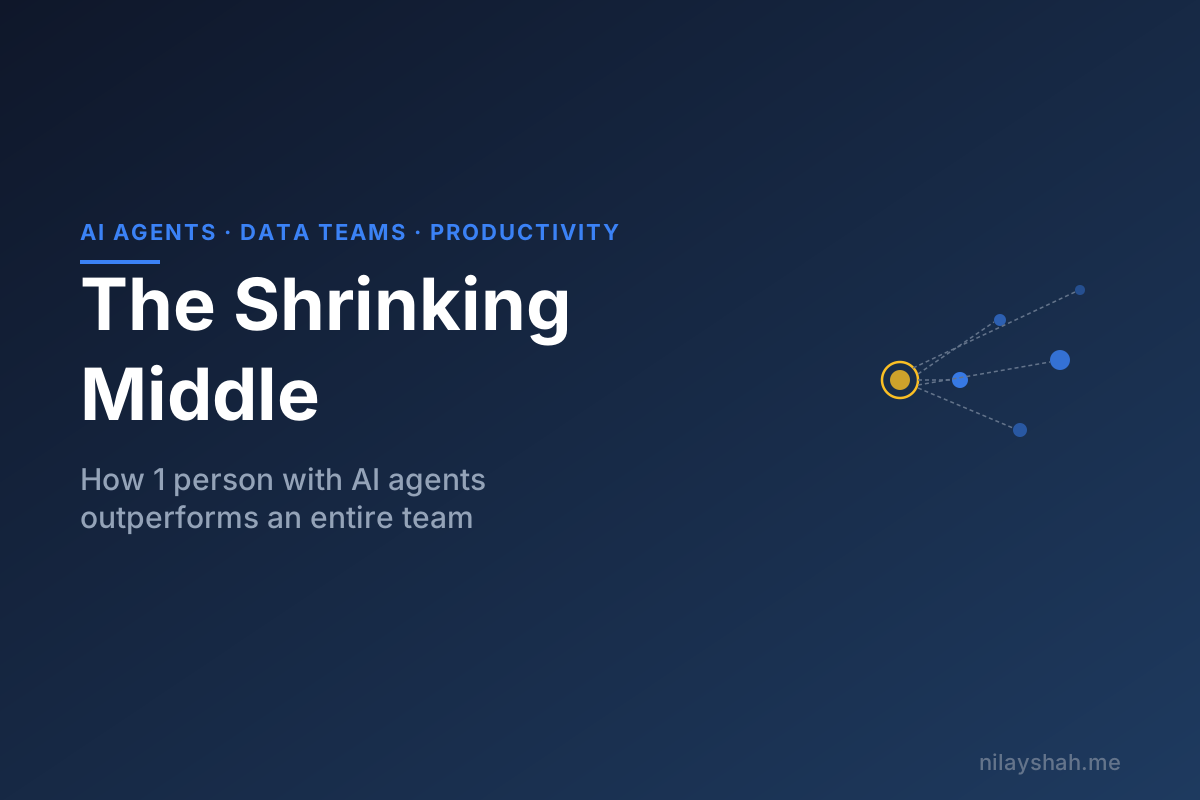
What does this actually look like in practice, for a principal data architect/engineer managing a platform domain? The diagram below shows the operating model: one senior professional at the center, directing a layer of specialized AI agents, each owning a defined scope of autonomous execution, with explicit escalation paths back to the human for anything requiring judgment.
The key word is “directed.” These agents do not run unsupervised. Each one of AI agents has a defined scope: what it monitors, the conditions under which it acts autonomously, the thresholds at which it escalates, and the audit trail that makes its decisions reviewable. The architect sets those parameters, adjusts them when the agent performs incorrectly, and evolves them as the domain changes.
This is where the “right person” condition matters. AI agents configured by someone without deep domain knowledge will produce plausible-looking output that is subtly wrong in ways that are hard to catch. An agent configured by a principal architect who understands the data deeply will escalate the right things, catch the anomalies that matter, and require minimal correction. The skill being rewarded is not “ability to use AI tools.” It is “depth of domain judgment applied through AI agents and AI tools.” Those are very different things, and the gap between them is where productivity gains either compound or collapse.
The Multiplication Formula
One principal architect + four well-configured agents = the effective output of a team of six to eight, on domains that are well-defined and stable. The ceiling is not the agent count. It is the quality of the judgment at the center.
What Actually Is at Risk: The Junior Routine-Task Layer
The force multiplication story is real, but it does not apply uniformly across experience levels. To be direct about what is happening: entry-level roles defined primarily by routine execution are structurally at risk.
The specific work that disappears first is not creative, not judgmental, and not relational. It is the data engineering work that looks like this: running daily ETL validation scripts, generating standard weekly reports from pre-defined templates, cleaning and standardizing ingested data according to established rules, updating documentation when schema changes are flagged, and monitoring pipeline health during business hours. These tasks are learnable by AI agents. And they are also, historically, how junior data engineers learned the platform.
That is the real structural challenge. The agent absorbs the routine work and simultaneously removes the on-ramp through which junior talent used to develop judgment. Organizations navigating this well are building explicit judgment development programs for junior engineers, structured exposure to the decisions that agents surface for escalation, rotations through architecture review processes, and deliberate mentorship from senior principals. AI agents do not make junior experience unnecessary. It makes it harder to acquire by accident, and it requires intentional scaffolding to replace what used to happen organically.
The Junior Pipeline Problem
If every entry-level task is handled by an agent, where do future senior engineers come from? The organizations building durable teams in 2026 are not just deploying agents they are redesigning how junior engineers develop judgment in a world where the routine work they used to learn from is no longer available to them.
The Contrarian Take: Agents Make Bad Senior People Dangerous
There is an uncomfortable edge to the force multiplication story. If agents amplify the output of the person directing them, they amplify both good and bad judgment.
A senior architect with deep domain knowledge and clear mental models will configure AI agents that catch real problems, escalate correctly, and generate genuinely useful outputs. A senior architect who is overconfident, shallow in their domain understanding, or poor at defining scope will configure agents that produce plausible-but-wrong outputs at high velocity and those outputs will find their way into dashboards, reports, and downstream decisions before anyone catches them.
HBR’s May 2026 research found that treating agents like employees extending them implicit trust based on role definition rather than explicit governance breaks down in production precisely because agents will not tell you when they are out of their depth. They will produce an answer regardless. The discipline required is not “how do I deploy more agents?” but “how do I build the feedback loops that surface agent errors before they compound?”
The organizations succeeding with this model share one practice: they invest as much in agent review and calibration as they invest in agent deployment. The principal architect who spends an hour a week reviewing agent outputs and adjusting escalation thresholds outperforms the one who deploys broadly and assumes the outputs are correct. Scale without oversight is not multiplication. It is amplified noise.
One Tool Worth Attention: LangGraph for Human-in-the-Loop Orchestration
For teams beginning to build these human-agent operating models, LangGraph is worth understanding. It provides a framework for building stateful, multi-agent workflows as directed graphs, where each node can be an agent, a tool call, or an explicit human review checkpoint.
The human-in-the-loop node is the architectural feature that matters most for data teams. It allows a workflow to pause at a defined condition, surface the relevant context to a human reviewer, and resume based on their decision. For a data quality monitoring agent, the escalation path anomaly detected, surfacing to principal for review before downstream alert is sent, is not bolted on. It is designed in as a first-class node. This pattern is the difference between agents that build trust over time and agents that erode it.
The Cost Equation Nobody Budgeted For
Here is the part of the agent amplification story that gets skipped in the presentations: AI agents, deployed at production scale with always-on operation, can cost more than the people they are supposed to replace.
In April 2026, a senior Nvidia executive said plainly: “The cost of compute is far beyond the costs of the employees.” A month later, Microsoft’s own internal reporting confirmed that using AI at scale is currently more expensive than paying human employees for equivalent work. These are not critics of AI speaking. These are the people building it.
The specific mechanism is the token multiplier problem. A standard chatbot interaction consumes one LLM call. An agentic workflow where an agent reasons iteratively, breaks down a task, calls tools, verifies its output, and self-corrects triggers between 10 and 20 LLM calls to complete a single task. Gartner’s March 2026 analysis puts agentic token consumption at 5 to 30 times that of a non-agentic model. This is why pilot economics routinely fail to predict production costs. The pilot runs a handful of agent tasks. Production runs thousands per day. The bill arrives and organizations realize their model was wrong by an order of magnitude.
The Numbers
Uber burned through its entire 2026 AI tooling budget in four months. An unnamed enterprise accidentally spent $500 million in a single month on AI API calls after deploying access with no usage caps. A 2026 cost analysis estimates that a mid-market enterprise with 5,000 employees now spends $9–19 million annually on AI infrastructure and 80% of those organizations miss their AI spending forecasts by more than 25%.
The aggregate ROI picture is equally sobering. Only 1% of enterprises report significant ROI of 20% or more from AI. 30% of generative AI projects are abandoned after proof of concept not because the technology failed technically, but because the business case collapsed when real costs became visible. The pattern that emerges in organization after organization is the same: leadership hears about productivity gains, approves a broad rollout to “stay competitive,” and discovers six months later that the compute bill has grown faster than any measurable output improvement. This is not AI failure. It is governance failure specifically, the failure to ask “what exactly will this agent do, for how many tasks per day, and what is that worth to us?”
The Jevons Paradox of AI Spend – Token prices have fallen 280x over the past two years. Total enterprise AI spend has risen 320% in the same period. Cheaper tokens do not reduce bills when agentic architectures consume 10–20x more tokens per task and organizations deploy broadly without usage governance. The unit cost improves; the total cost compounds.
The cost structure will improve. Gartner forecasts inference costs will fall more than 90% by 2030 as model efficiency and hardware economics converge. The organizations that build disciplined deployment practices now that automate what delivers clear, measurable value per task rather than what is technically possible will be positioned to scale rapidly when the cost curve bends. The organizations that chase the trend without a cost model will have spent the budget before the economics get good.
The Test Worth Applying
Before deploying any agent at production scale, answer three questions: What specific task does this agent execute, how many times per day, and what is the measurable value of each execution? If the answers are vague, the cost model will be wrong. Agents deployed against well-scoped problems with honest cost models will outperform. Agents deployed because a competitor announced an AI initiative will cost more than they produce, with high reliability.
What This Means If You Are a Senior Engineer or Architect Today
The opportunity in front of senior data professionals right now is significant. The tools exist to multiply your output in ways that were not possible two years ago. The architects and engineers who invest in learning to configure, govern, and continuously calibrate agent systems who develop a personal agent stack the way earlier engineers developed a personal toolkit are building a durable productivity advantage.
The investment is not trivial. It requires learning a new layer of abstraction: not just how to build data systems, but how to build systems that direct other systems. It requires discipline around governance that most engineers have not had to apply at this layer before. And it requires a clear-eyed view of what agents can do reliably and where they consistently need human correction.
But the ceiling has moved. A well-configured senior professional with the right agent stack is not competing with other senior professionals who lack agents. They are operating at a different effective capacity entirely.
Rule of Thumb
The question is not “will AI replace my team?” It is “am I the kind of person whose output multiplies with agents, or the kind whose output gets replaced by them?” The difference is judgment depth, not job title. Build the agent stack before someone builds it around you.
References
- To Scale AI Agents Successfully, Think of Them Like Team Members — HBR, March 2026
- Research: Why You Shouldn’t Treat AI Agents Like Employees — HBR, May 2026
- Create an Onboarding Plan for AI Agents — HBR, March 2026
- To Thrive in the AI Era, Companies Need Agent Managers — HBR, February 2026
- Agentic AI Adoption Statistics 2026 — Axis Intelligence
- Agentic AI Orchestration: Automating Workflows at Scale — OneReach.ai
- AI Agent Adoption in 2026: What the Analysts’ Data Shows — Joget
- Enterprise Architecture Trends, Skills & Strategies 2026 — Avolution
- LangGraph — LangChain
- “The cost of compute is far beyond the costs of the employees” — Fortune / Nvidia, April 2026
- Microsoft Reports: AI More Expensive Than Human Employees — Fortune, May 2026
- Gartner: Inference Costs to Fall 90% by 2030 — March 2026
- The Enterprise AI Cost Crisis — $9–19M/Year and Nobody Can Prove the ROI — FourWeekMBA
- AI ROI Explained: Why Enterprise AI Spending Is Failing in 2026 — Sparity
- AI Agents Burn 50x More Tokens Than Chats — LeanOps
- How to Get AI Agent Budgets Right in 2026 — CIO